Enclosures v2 — Manual
2. Interface
3. Core Parameters
4. Generation Modes
Requirements
Enclosures v2 requires Ableton Live 12 or later and Max 9 or later.
Known issue: a bug in Max could cause a crash when using mappings, due to an invalid path in the JS Live API (jsliveapi_setpathfromid).
This issue is resolved in Max 9.0.9 or later.
If you experience crashes related to mappings, updating Max to 9.0.9 or above is recommended.
1. Overview
Enclosures is a multichannel envelope generator designed for animated, continuously variable modulation.
The module outputs 8 independent envelopes.
Each envelope is generated from the same mode characteristic,
then differentiated per channel through internal variation controls.
The mode system provides 39 envelope algorithms, each with a distinct geometric and temporal behavior.
Depending on the selected mode, envelopes can range from stable and minimal
to dense, oscillatory, or strongly deformed trajectories.
2. Interface
The interface is organized into several functional areas,
each dedicated to a specific aspect of envelope generation and modulation control.
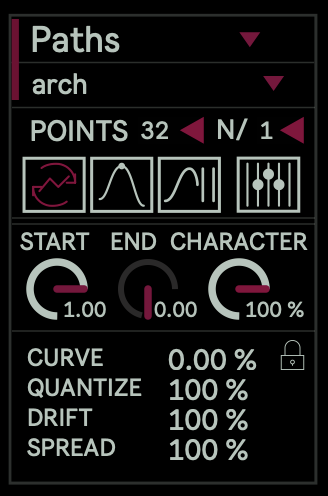
Defines how envelopes are generated. The module generates an envelope for each incoming Note On event.
Mode Selector: selects the generation algorithm. Each mode defines a specific behavior for time distribution and value evolution.
Points: controls the number of breakpoints in the envelope. Higher values increase structural complexity.
N/: triggers the envelope once every N incoming note-on events.

Deform: modifies the current envelope while preserving its overall structure.
Hold: reuses the same envelope without any change (useful for manual editing).
Toggle Quantize: instantly forces the Quantize parameter to its maximum (full quantization) or minimum (off).
Start / End, Character, Curve, Quantize, Drift, Spread: global generation parameters (see Core Parameters).
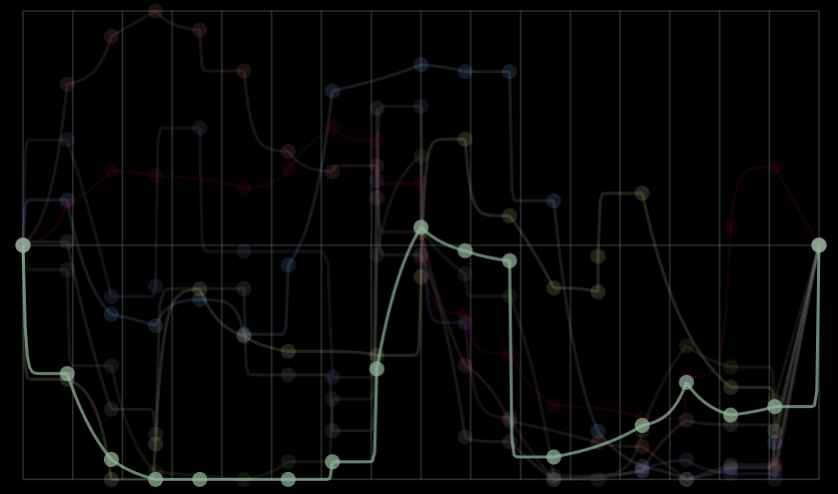
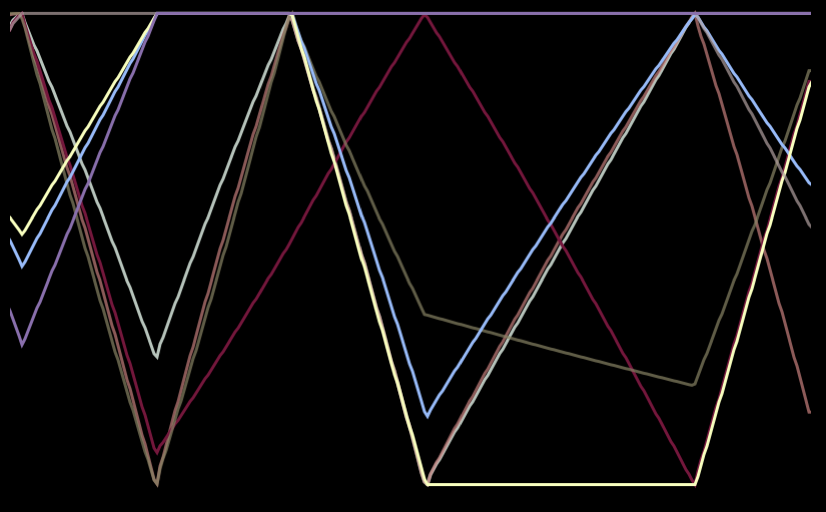
A multi-layered visual representation of the generated envelopes.
Each line represents one envelope channel. All envelopes share the same start and end points.
Differences between trajectories reflect the current generation mode and parameter settings.
This display reflects the actual modulation signals being produced.
The view can be switched between function view (envelope shape) and scope view (live output signals) — see View in Time & Trigger Control.
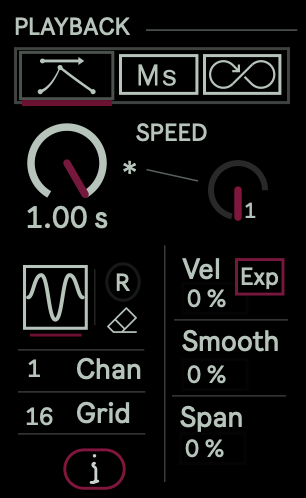
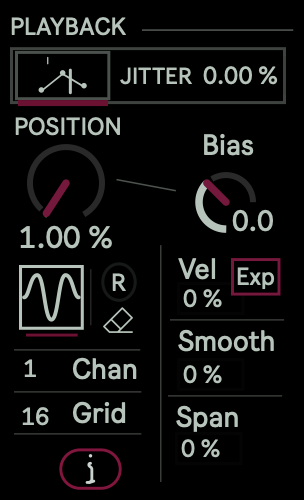
Time Mode (Ms / Sync): toggles between free-running duration in milliseconds and tempo-synchronized mode.
Loop: when enabled (loop icon), the envelope repeats continuously.
Rate Mult Factor: multiplies the envelope playback speed by a fixed coefficient.
Span: rhythmic divergence across the 8 channels — see 2.1 for details.
Jitter: amount of jitter around the scanned position.
Bias: distribution of the scan across the envelope — see 2.1 for details.
Span: temporal divergence across the 8 channels — see 2.1 for details.
2.1 Playback Modes
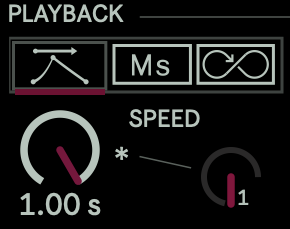
Envelope progression is driven by a playback rate,
either in free frequency (Hz) or synchronized to host tempo
(relative clock division/multiplication).
Rate Mult Factor: multiplies the envelope playback speed by a fixed coefficient.
Span: rhythmic divergence across the 8 channels — see Time & Trigger Control.
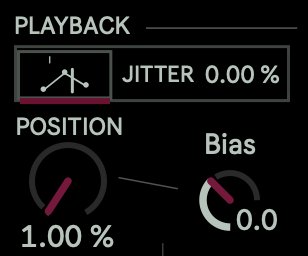
Envelope playback is replaced by direct position scanning.
The shape is read from a manually controlled position parameter,
allowing static reads or externally driven traversal.
Position: scrolls through the envelope shape.
Jitter: amount of jitter around the scanned position.
Span: temporal divergence across the 8 channels — see Time & Trigger Control.

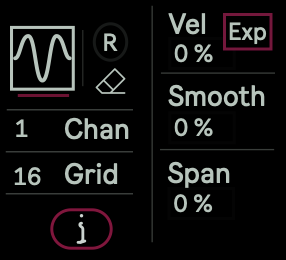

Clear (eraser icon): clears the envelope function, leaving a blank canvas for manual drawing. Automatically activates Hold mode.
Chan: forces the display to focus on a specific channel (1–8). Useful for inspecting or drawing on a single channel independently.
Grid: defines the grid size.
Info: opens this manual page in the browser.
Velocity Mapping (Lin / Exp): controls how incoming MIDI velocity affects envelope intensity.
Smooth: applies smoothing to all output signals.
Scan mode: temporal divergence across the 8 channels. At 0, all channels track the Scan position simultaneously. As Span increases, the stretch ratio assigned to each channel is remapped to a transition time, progressively expanding the range of possible transition durations and causing the Scan gesture to unfold over time.
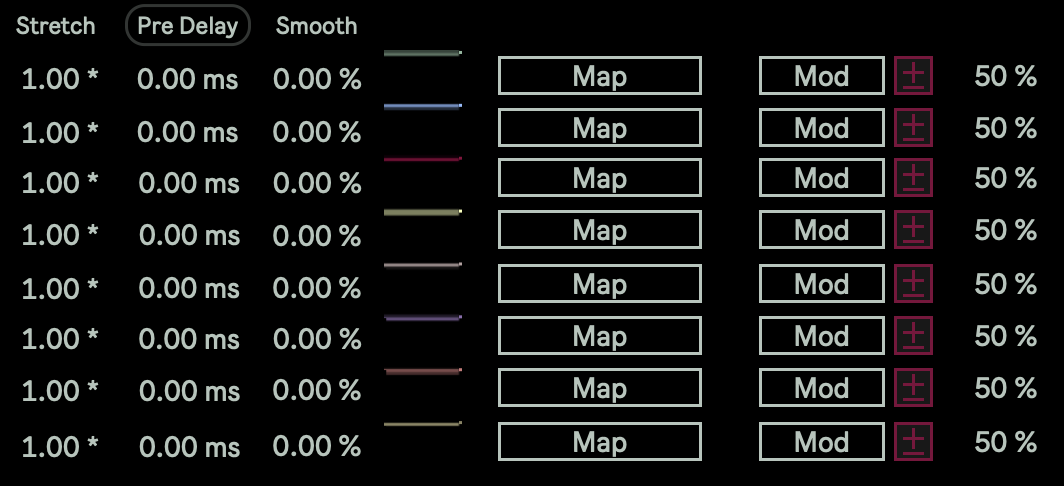
Each envelope channel can be independently processed.
Stretch: scales the duration of the envelope.
Pre-Delay: adds delay before envelope playback. Click label: random per envelope. Double-click: reset to 0.
Smooth: applies per-channel smoothing.
Map: assigns the envelope to a target parameter. Choose between Remote (legacy) and Mod (Ableton 12 modulation). Use ± to flip the modulation polarity.
Min / Max: defines the output range of the modulation signal.
3. Core Parameters
Start
Defines the shared starting point from which all envelopes originate.
End
Defines the common destination point all envelopes converge to.
Character
Controls the structural intensity of the selected mode.
At low values, the mode remains restrained and its signature is lightly expressed.
At higher values, the intrinsic character of the selected mode is pushed forward
and becomes clearly pronounced, with stronger mode-specific traits.
Curve
Controls interpolation between breakpoints.
At 0%, segment interpolation is linear.
As the value increases, interpolation becomes exponential relative to segment direction
(upward or downward slope), which changes perceived attack/release dynamics.
Quantize
Attracts internal breakpoints to a musical grid based on the number of points
(e.g. 8 points = eighth notes, 16 = sixteenth notes).
At 0, positions are free. At 1, full snap to grid.
In-between values create partial attraction — from rubato to metronomic.
Drift
Controls trigger-to-trigger evolution of breakpoint timing and level.
At 0%, envelope playback is repeatable.
As the value increases, internal points progressively shift over successive triggers,
introducing controlled wandering and instability in the envelope trajectory
while maintaining bounded behavior.
Spread
Controls divergence across the 8 channels.
At low values, channels remain closely correlated.
At higher values, per-channel timing, amplitude, and internal motion diverge,
increasing spatial and behavioral separation.
Per-channel processing is intentionally documented once in 2. Interface
to keep this manual compact and avoid duplicated descriptions.
4. Generation Modes
Each envelope in Enclosures v2 is generated by a mode —
an algorithm that shapes the path from a start value to an end value.
Modes are grouped by class.
Each mode has a Character parameter
that controls its behaviour from subtle to extreme.
PATHS
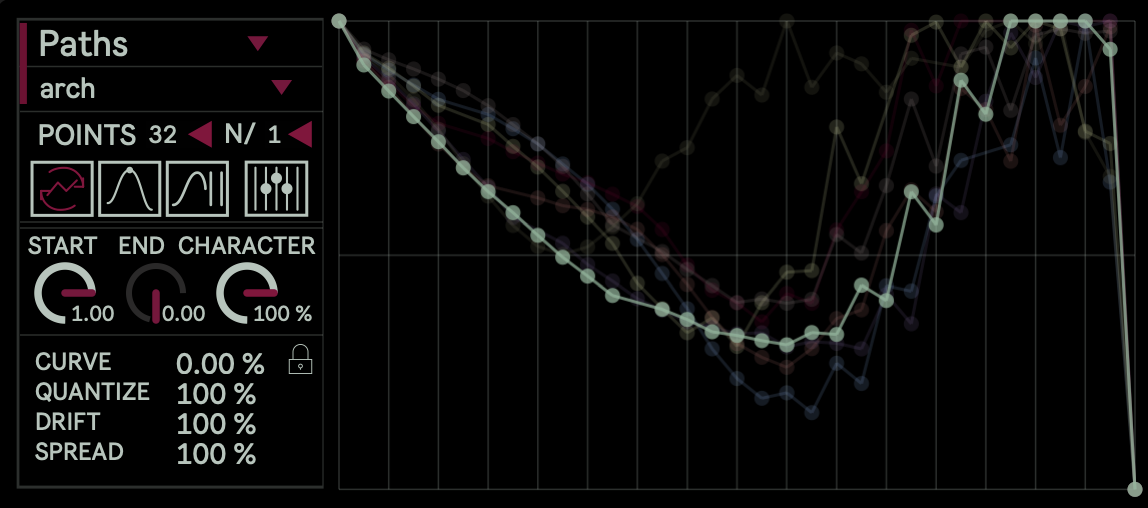
Concept: A lifted phrase that rises, peaks, then settles back.
Character: low = shallow arch, near linear; high = taller arch with a clearer peak shifted left or right.
Drift: low = still apex; high = a wind-like flutter at the summit grows in amplitude, width and frequency — the arch vibrates under strain.
Spread: low = channels share the same apex; high = per-channel jitter of apex position and arch height.
Try it for lifted, intentional phrases that rise, peak, then return.
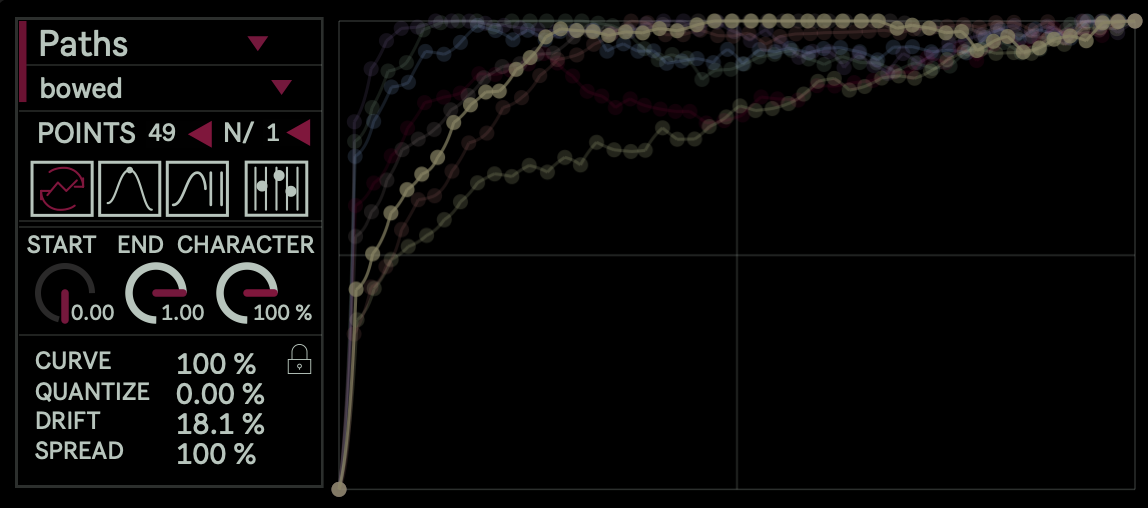
Concept: It mimics a bowed gesture: slow tension build, then controlled release.
Character: low = gentle curve; high = stronger bend and more pronounced acceleration profile.
Drift: low = stable arch; high = internal points are jittered in time and value — the bow shudders slightly.
Spread: low = channels share the same curve and swell shape; high = per-channel jitter of arch exponent, swell peak position and amplitude — each channel has its own bowed profile.
Try it for any gesture that needs physical weight: a bowed note, a drawn breath, a pressed key.
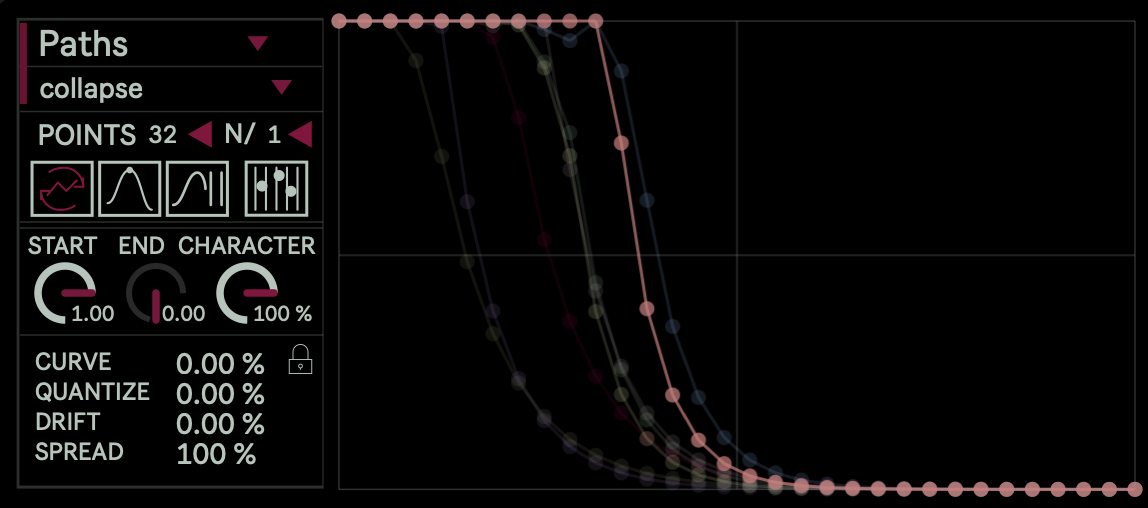
Concept: A structure that seems stable, then suddenly gives way.
Character: low = smooth, controlled decline; high = abrupt near-vertical collapse.
Drift: low = predictable break point and fall speed; high = break point and fall stiffness become highly variable, with pre-break tension oscillations and time warping.
Spread: low = channels collapse together; high = per-channel jitter of break point and fall speed — structures give way independently.
Try it for breakpoints that should feel like a structure giving way at the last moment.
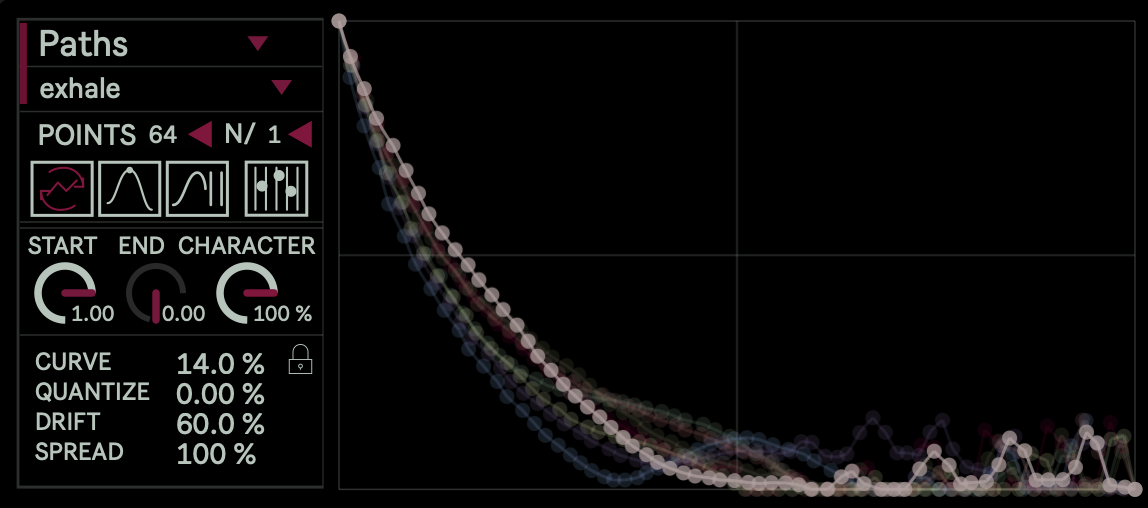
Concept: The complement of whisper — where whisper holds and releases late, exhale gives everything immediately and slowly fades.
Character: low = gentle near-linear release, barely any flutter; high = sharp initial drop, long quiet tail, and pronounced tremolo as the last air escapes.
Drift: low = flutter onset is stable; high = onset shifts unpredictably — some envelopes hold steady for longer before the tremolo begins.
Spread: low = channels exhale alike; high = per-channel decay steepness and flutter amplitude — each channel has its own breath character.
Try it for filter frequency sweeps, kick envelope shaping, and any exponential release that should feel immediate and definitive.
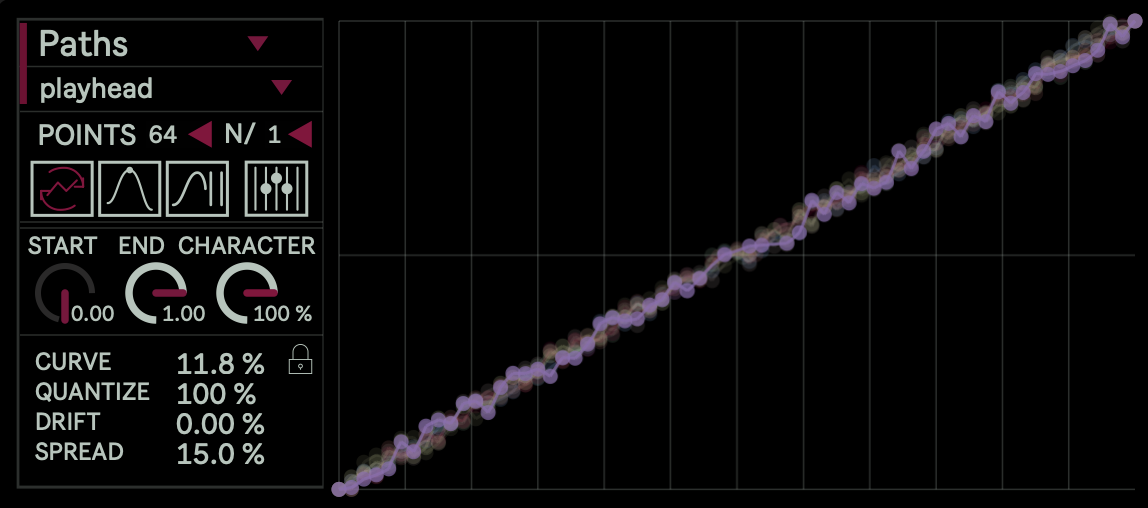
Concept: Models a sampler playhead moving steadily from startValue to endValue. The trajectory is linear at its core, but each point is slightly displaced in time and value — as if fine dust on a groove causes imperceptible micro-skips.
Character: low = barely perceptible grain, practically clean; high = clearly noisy yet unambiguously forward-moving.
Drift: low = grain stays as generated; high = slow value wandering and temporal displacement layer on top of the micro-perturbations — the read head feels more worn and irregular.
Spread: low = all channels advance at the same pace; high = per-channel roughness — some channels read cleanly, others feel more worn.
Try it for sample playback positions, slowly modulated read heads, or any parameter that should advance steadily but imperfectly.
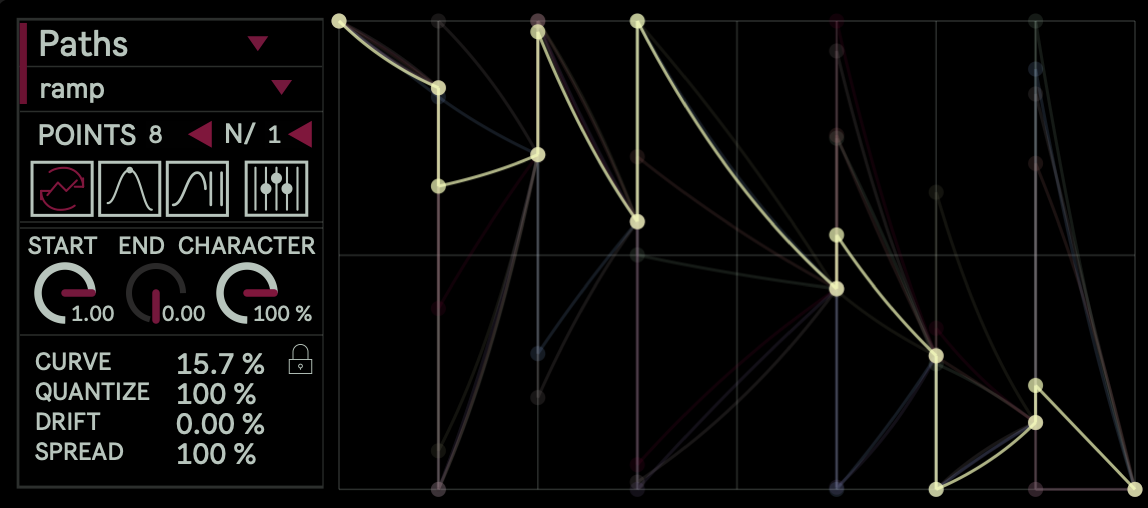
Concept: The neutral reference shape, ideal when you want pure, direct motion.
Character: low = perfectly linear and clean; high = sudden vertical jumps appear between points, so the ramp becomes broken and unpredictable.
Drift: low = abrupt jumps; high = the same jumps are progressively smoothed into fast ramps.
Spread: low = channels share the same jump amplitudes; high = per-channel jitter of jump size.
Try it for readable, direct transitions, or to injecting controlled discontinuities.
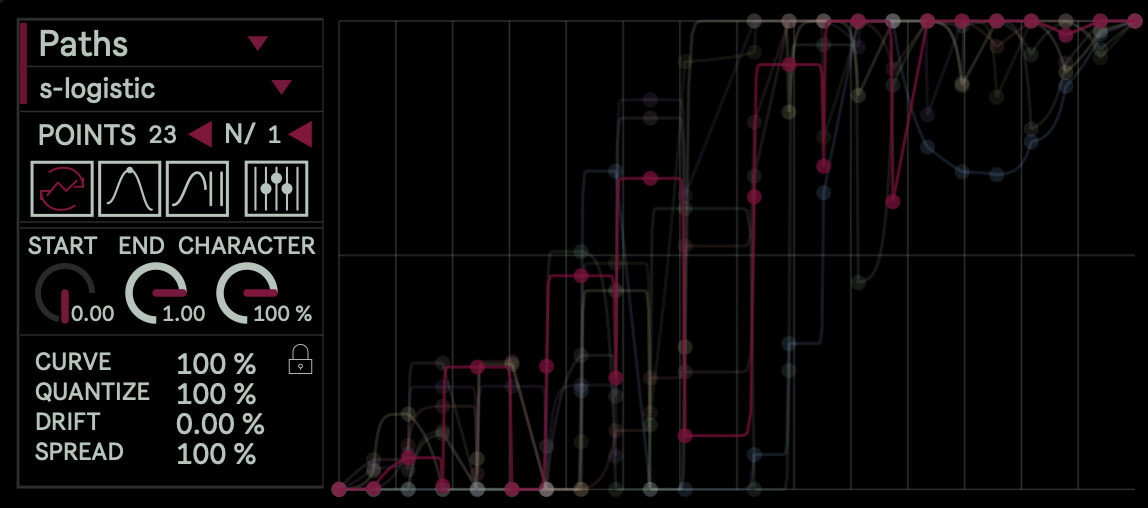
Concept: A controlled move that can morph from clean intention to living instability.
Character: low = almost pure S-curve; high = dense chaotic modulation across the whole envelope.
Drift: low = stable behavior over time; high = the curve moves through calmer and wilder zones inside one envelope.
Spread: low = channels stay close; high = channels diverge strongly, each taking a noticeably different path.
Try it for modulations that move with the logic of an S-curve while carrying instability inside that same arc — precise shape, turbulent interior.
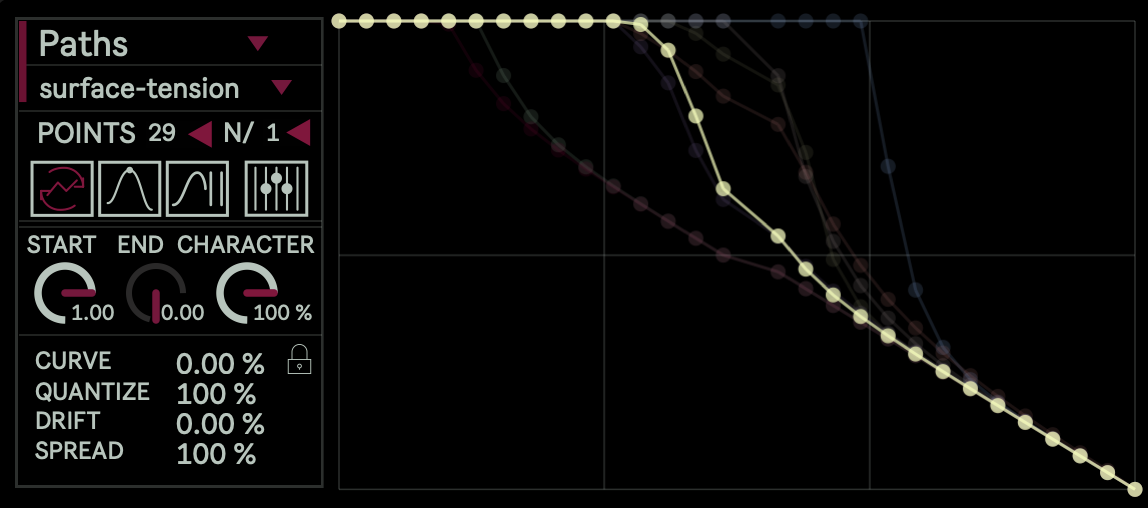
Concept: A stretched membrane that finally ruptures.
Character: low = later break, slower collapse, calmer profile; high = earlier/unpredictable break with faster collapse and taller tension shape.
Drift: low = stable break position and collapse speed; high = break point and collapse speed jitter unpredictably.
Spread: low = channels rupture the same way; high = per-channel jitter of peak position and dome height.
Try it for fragile states that hold, then suddenly fail.
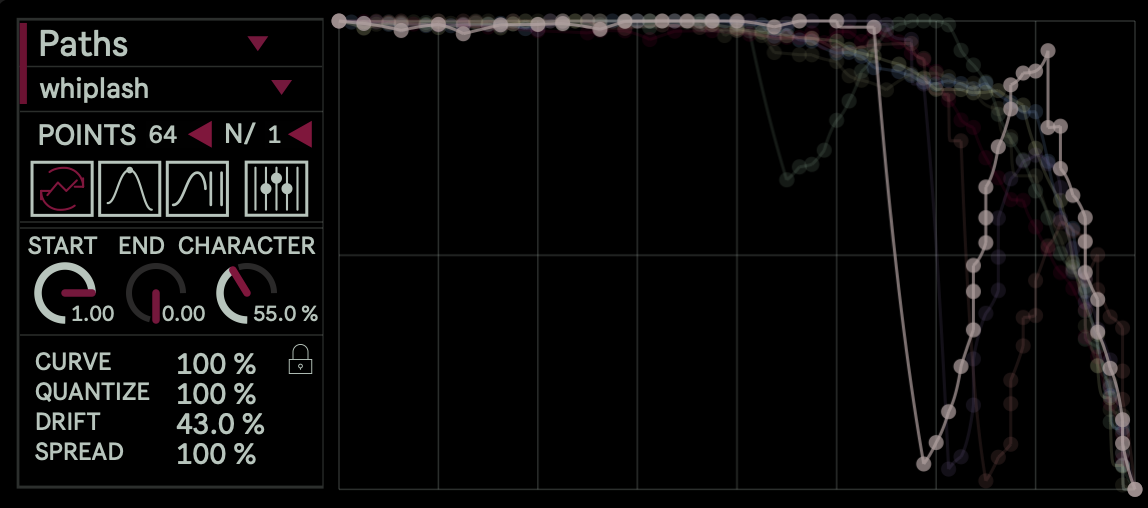
Concept: A whip concentrates all energy into one crack — preceded by an opposing pull and followed by a rebound.
Character: low = wider, softer crack with mild rebound; high = narrow, hard, later crack with strong rebound and denser tail.
Drift: low = tight, precise transient; high = slight timing and value uncertainty on non-structural points.
Spread: low = all channels crack at the same moment; high = strongly staggered crack timing with per-channel snap amplitude and tail frequency.
Try it for violent, cathartic accents where everything culminates in one instant.
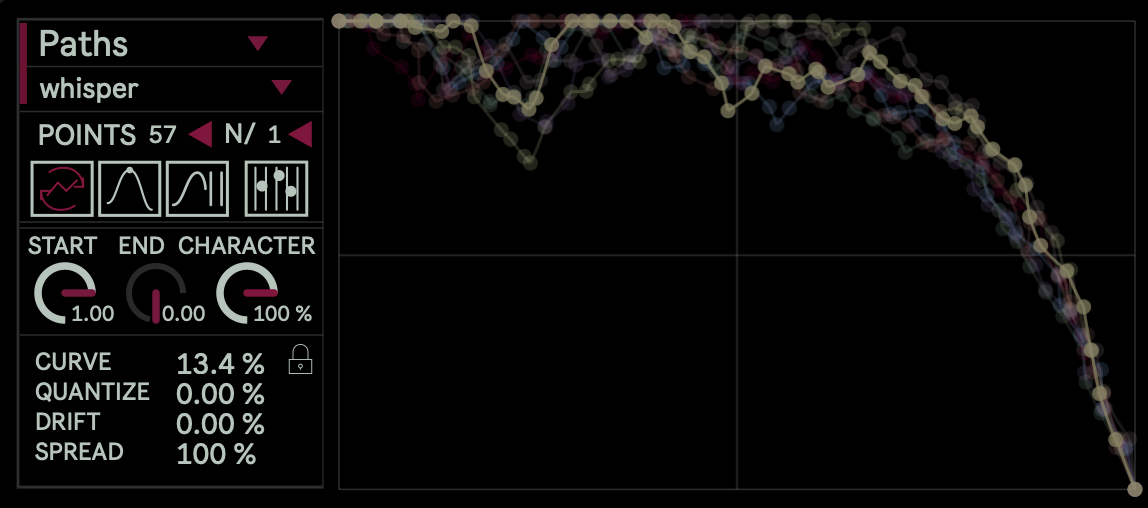
Concept: A held breath that releases near the end.
Character: low = mild, soft acceleration; high = very quiet start and fast, late arrival.
Drift: low = held shape stays clean before the late release; high = slow value wandering and temporal displacement add breath-like instability to the quiet phase.
Spread: low = channels breathe alike; high = per-channel fundamental frequency jitter — a chorus of breaths at slightly different pitches.
Try it for fades or modulations that should feel restrained at first, then suddenly commit.
OSCILLATIONS
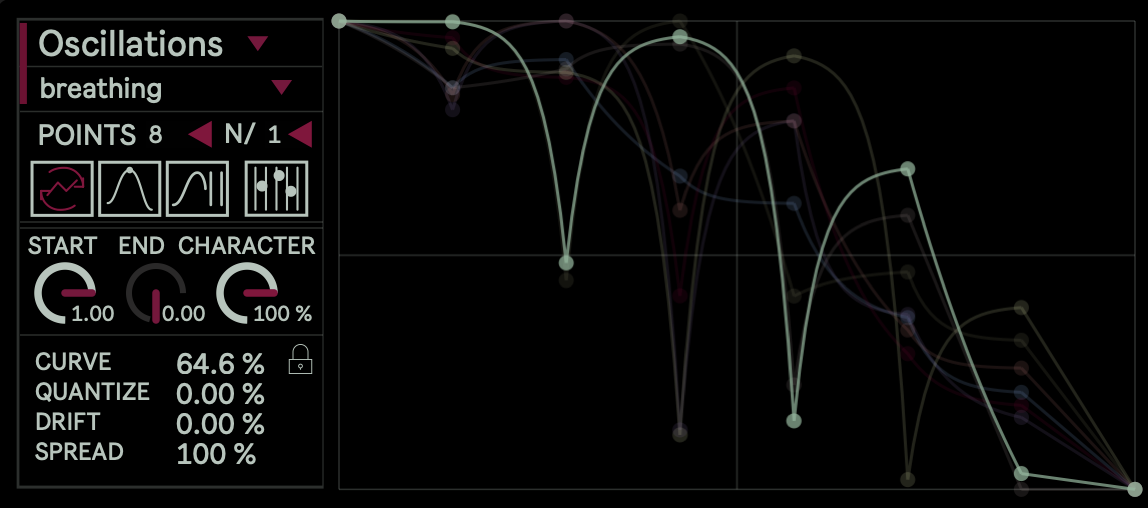
Concept: Inhale/exhale motion, soft and cyclical.
Character: low = fewer, smaller waves; high = more cycles and stronger amplitude.
Drift: low = steady breath depth; high = breath depth evolves across the envelope — the breathing deepens or fades over time.
Spread: low = channels breathe in sync; high = per-channel cycle count and breathing phase offset — some channels inhale while others exhale.
Try it for pulsing motion that feels natural and organic.
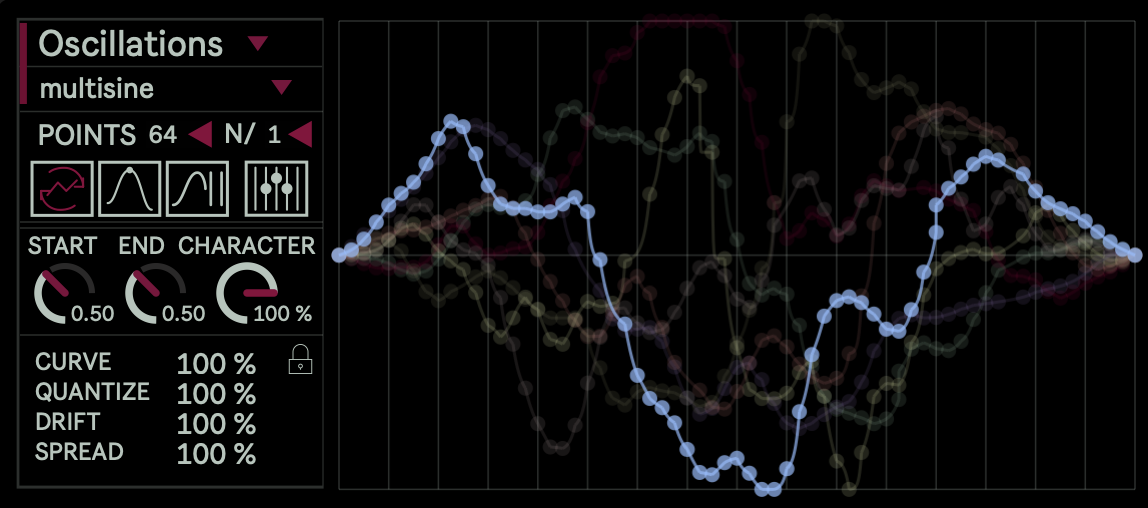
Concept: Several simple waves fuse into one animated, musical contour.
Character: low = simpler wave mix; high = denser harmonic content and more detailed movement.
Drift: low = fixed phase relationships; high = per-partial phase drift that continuously morphs the spectral blend over time.
Spread: low = channels share the same timbre; high = per-channel partial-amplitude jitter — each channel has its own spectral color.
Try it for rich harmonic LFO shapes, layered vibrato, or any oscillation that should feel multi-dimensional without losing musicality.
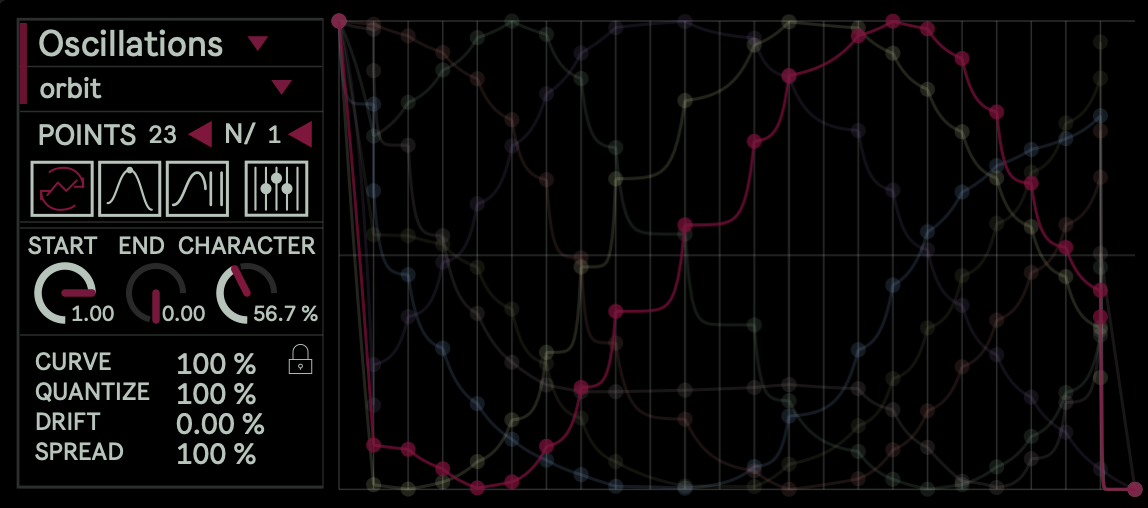
Concept: The envelope "orbits" its target, lingering in some zones and rushing through others.
Character: low = near-uniform timing; high = stronger elliptical timing contrast (clear slow/fast sections).
Drift: low = pure Keplerian motion; high = a non-Keplerian perturbation (as if a distant third body pulled on the orbit) wobbles the trajectory.
Spread: low = channels share the same orbit; high = per-channel eccentricity and inclination jitter — each channel follows its own orbital geometry.
Try it for motion that lingers then accelerates like an orbiting body — slow, weighted approaches followed by rapid passes, giving momentum a sense of gravitational pull rather than chance.
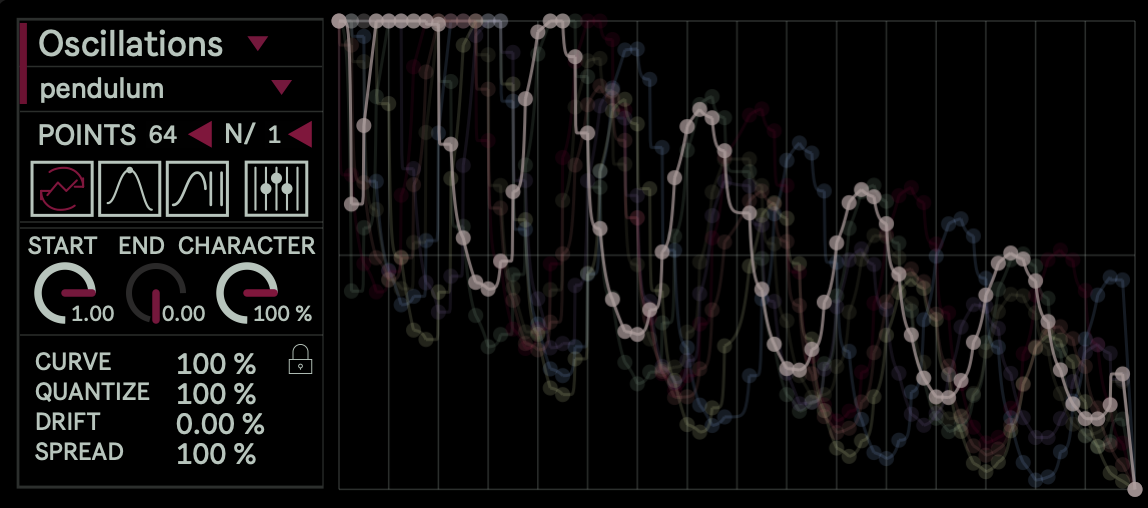
Concept: A suspended weight swinging side to side.
Character: low = smaller swing and faster settling; high = wider swing and slower damping.
Drift: low = stable swing; high = time and value jitter on internal points — the pendulum feels slightly buffeted.
Spread: low = channels swing in unison; high = per-channel jitter of frequency, damping, amplitude and phase offset — each channel follows its own pendulum geometry.
Try it for hypnotic, self-settling oscillation — a swing that slowly bleeds energy, drawing the ear into its decelerating rhythm.
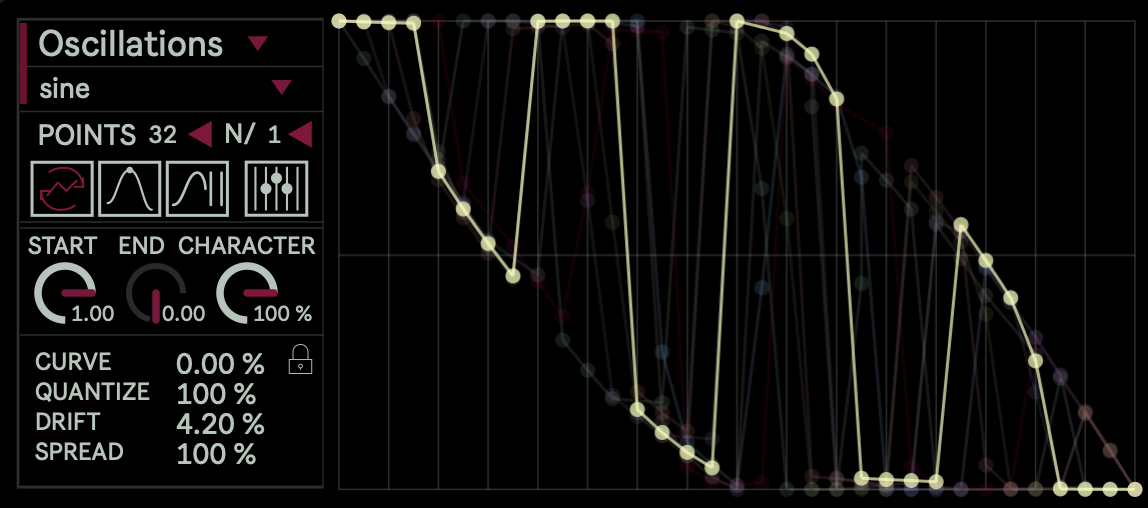
Concept: A pure periodic wobble with predictable rhythm.
Character: low = fewer cycles and lighter movement; high = more cycles and deeper oscillation.
Drift: low = steady phase; high = slow phase modulation, like a gentle vibrato inside the cycle.
Spread: low = channels stay in sync; high = per-channel cycle count and phase offset — channels beat against each other.
Try it for periodic motion that rides along a moving trajectory instead of oscillating in place — a clean wave whose phase can breathe and whose channels can beat against one another.
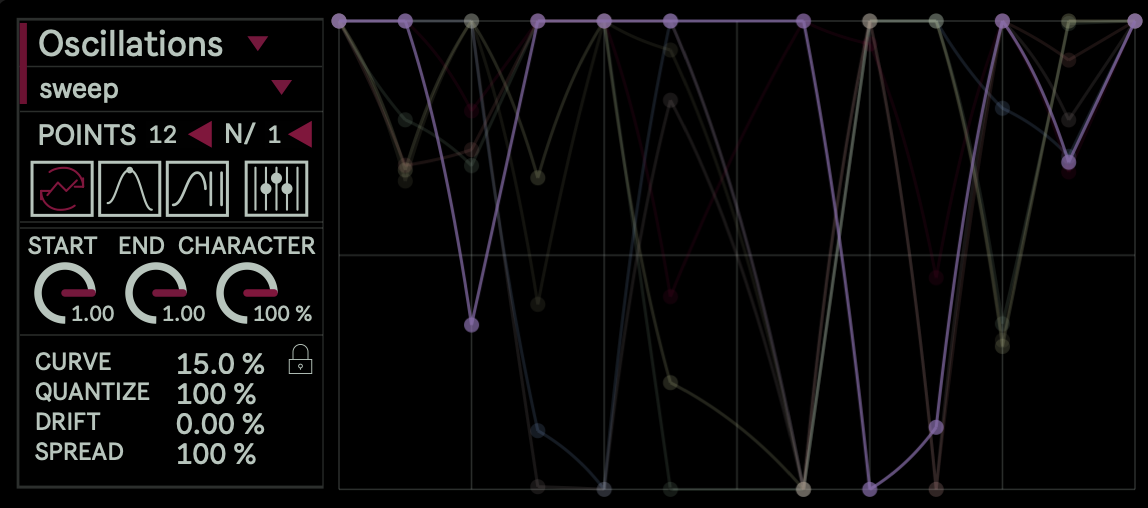
Concept: A steady sweep through the modulation range, more like scanning than striking.
Character: low = smoother, slower, more even travel; high = stronger directional push, wider excursion, and clearer acceleration/deceleration.
Drift: low = monotonic sweep speed; high = sweep clock wobbles — slowdowns and accelerations appear inside the pass.
Spread: low = channels sweep in sync; high = per-channel base frequency jitter — each channel scans from a slightly different pitch.
Try it for readable scanning motion or a pronounced pass across the modulation space.
KINETICS
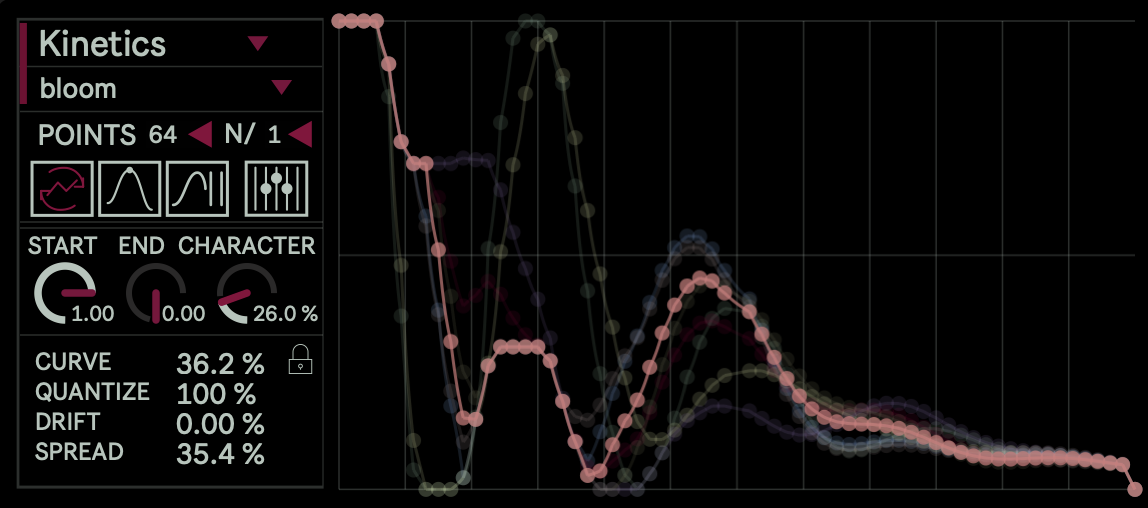
Concept: A motion that blooms open before fading.
Character: low = earlier and softer peak; high = later, larger peak with richer motion before decay.
Drift: low = stable peak and rebound arc; high = internal points are jittered in time and value — the bloom feels less precisely timed.
Spread: low = channels share the same oscillation; high = per-channel jitter of frequency, peak position, boost amplitude and damping — each channel blooms differently.
Try it for modulations that open up first, then relax.
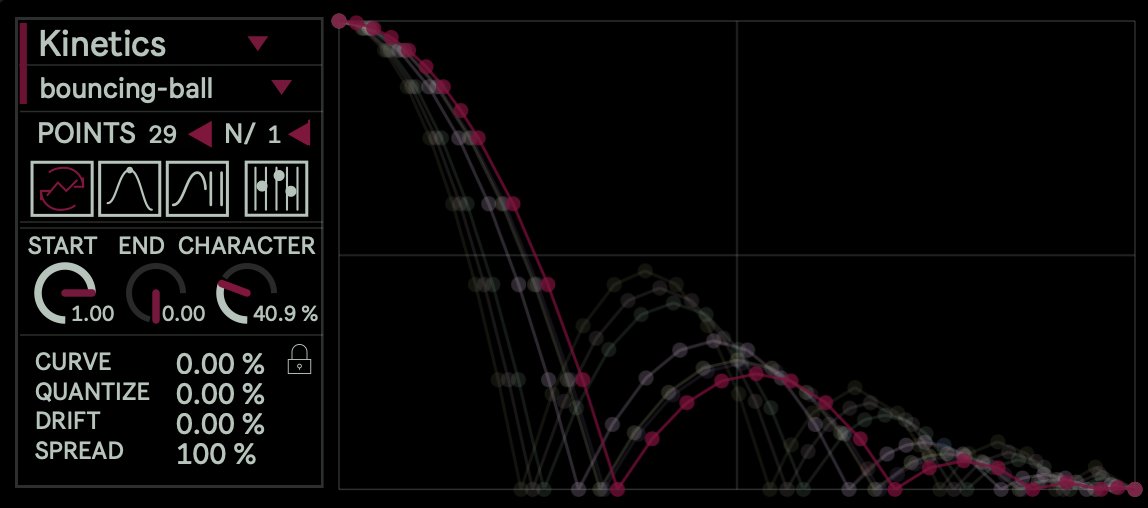
Concept: Repeated impacts that lose energy bounce after bounce, with gravity-shaped arcs.
Character: low = fewer bounces with soft gravity, floating feel; high = more bounces with stronger gravity, fast and physical.
Drift: low = clean, firm floor contacts; high = time jitter on in-air segments — impacts stay percussive, arcs feel buffeted.
Spread: low = channels share the same rebound heights; high = per-channel restitution offset — some balls bounce higher, others die sooner.
Try it for impact-like modulation and rhythmic decay gestures.
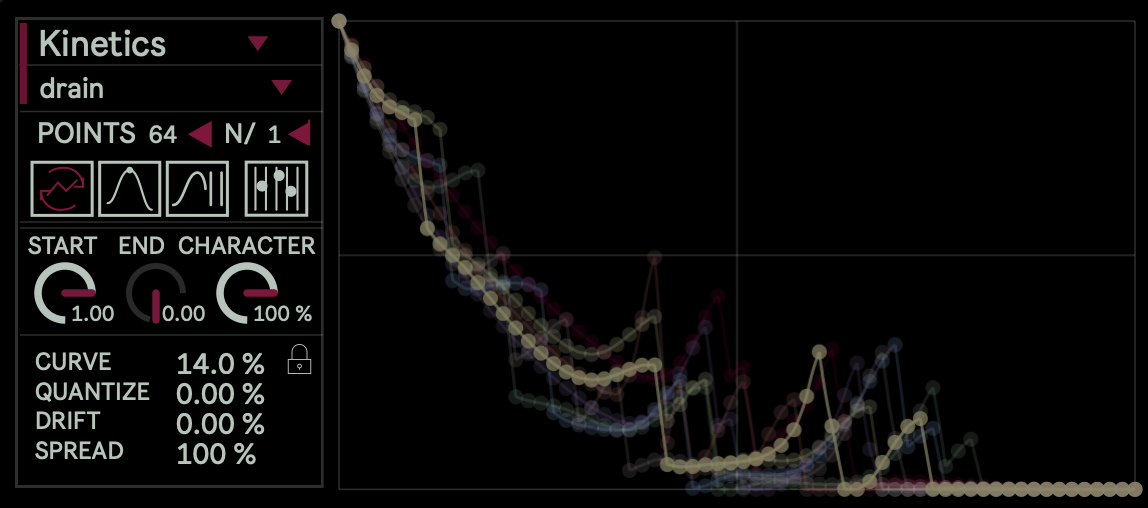
Concept: Flow is fastest when full; as the level falls, the outflow slows (Torricelli-like physics).
Character: low = gentle, gradual drain (viscous fluid); high = fast initial rush with discrete glug events — brief retentions of level before the flow resumes.
Drift: low = clean, steady outflow; high = glug intensity varies across events — some hold longer, others snap back faster.
Spread: low = channels drain at the same pace; high = per-channel exponent and glug count jitter — some channels empty quickly, others linger.
Try it for physical decay gestures: signal loss, fading pressure, or energy dissipation.
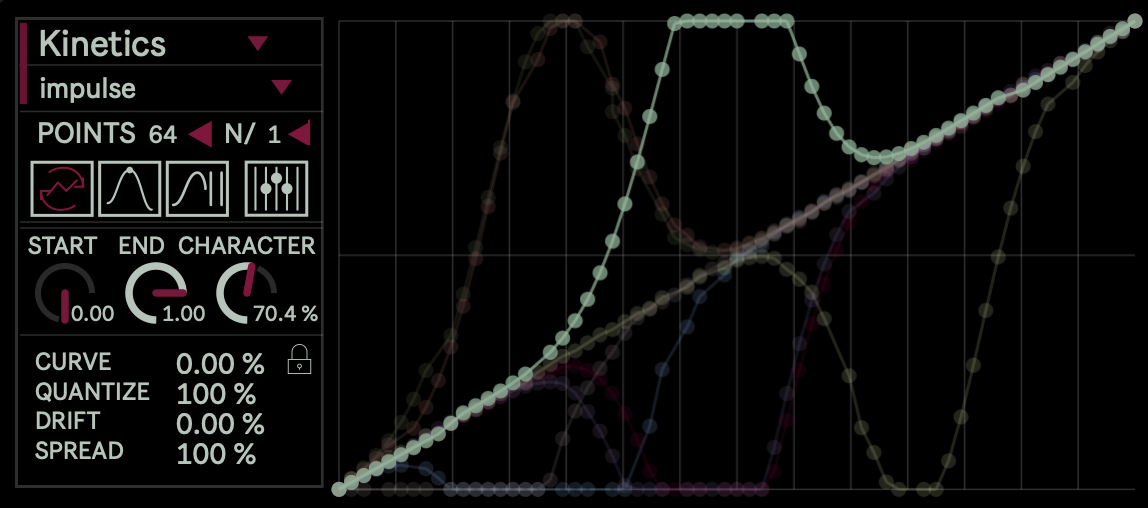
Concept: A single strike — hammer, plectrum, impact — brief and self-contained.
Character: low = soft, wide blow, elastic contact; high = precise, dry click, hard surface.
Drift: low = brief, nearly symmetric impulse; high = decay side extends asymmetrically — the strike lingers like a plucked string.
Spread: low = channels strike together; high = per-channel impact timing — each channel receives the blow at a distinct moment.
Try it for percussive emphasis inside an otherwise smooth move.
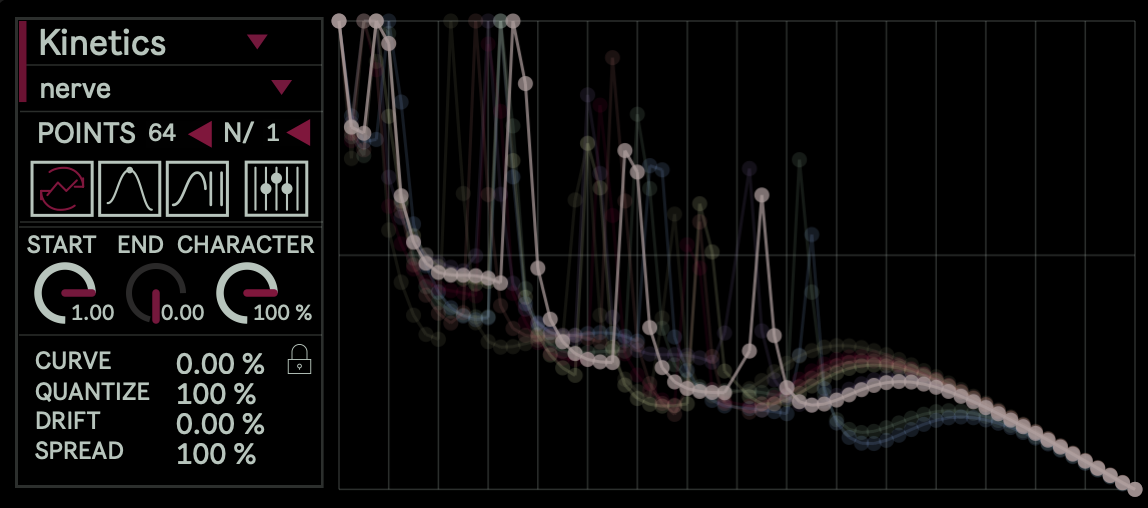
Concept: Neural-like firing: each spike has a sharp depolarization, a slower repolarization and an afterhyperpolarization, with amplitude decaying across the train.
Character: low = a single wide spike with light undershoot and long refractory period; high = more spikes, sharper peaks, deeper undershoots and tighter firing.
Drift: low = stable inter-spike interval; high = refractory period modulates across the train — the firing either tightens (growing excitation) or loosens (neural fatigue).
Spread: low = channels fire the same pattern; high = per-channel jitter of the spike count.
Try it for neural, twitch-like modulation and percussive articulations.
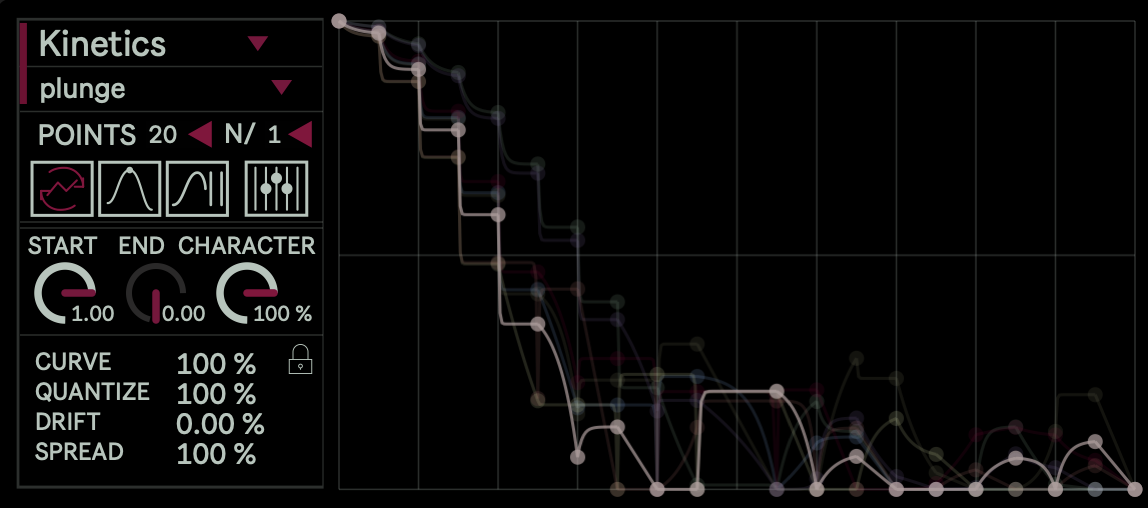
Concept: A drop into impact, then increasingly stiff rebounds.
Character: low = shorter fall and softer rebound; high = longer free-fall feel, stronger overshoot, stiffer late rebounds.
Drift: low = clean freefall and elastic rebounds; high = internal points are jittered in time and value — the drop feels less precisely aimed.
Spread: low = channels fall and rebound alike; high = per-channel jitter of freefall ratio, overshoot amplitude, frequency and damping — each channel takes its own trajectory.
Try it for the feeling of a dive — a committed fall that hits, then springs back in ever-tightening rebounds before coming to rest.
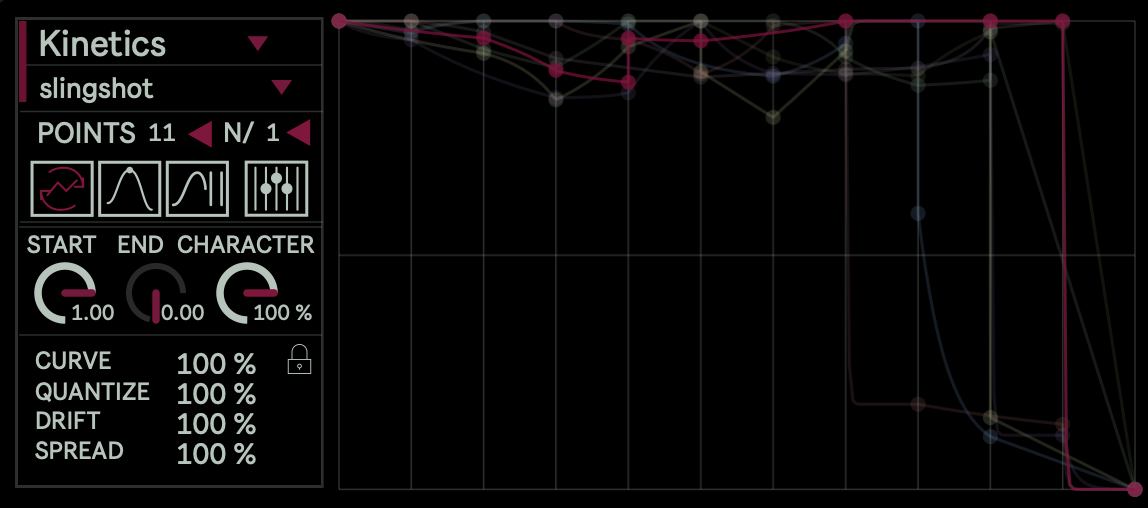
Concept: Tension first, release second, with a recoil tail.
Character: low = shorter pull and milder snap; high = longer pull, stronger release, bigger overshoot.
Drift: low = precise charge and snap; high = time and value jitter on internal points — the release feels slightly wobbled.
Spread: low = channels share the same charge and snap geometry; high = per-channel jitter of pull duration, pull amplitude, overshoot and post-snap oscillation — each channel has its own slingshot shape.
Try it for dramatic tension-and-release gestures — a backward charge that snaps forward past its target before recoiling into place.
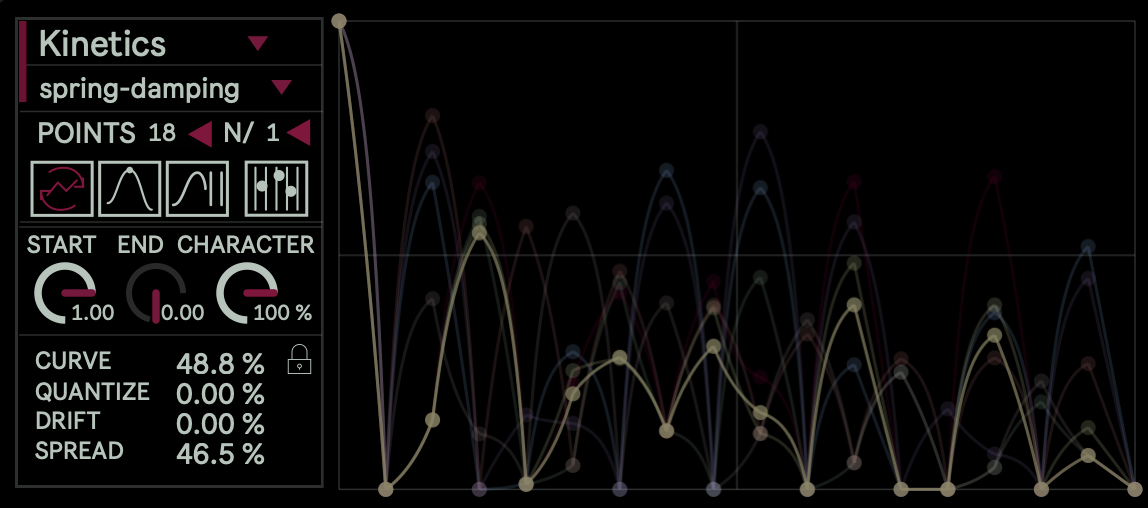
Concept: A hit-and-settle gesture like releasing a tense material.
Character: low = heavier, slower, more damped motion; high = lighter, brighter, faster oscillation with more ringing.
Drift: low = stable timing and values; high = extra jitter in time and amplitude.
Spread: low = channels ring with the same stiffness and damping; high = per-channel jitter of spring frequency and decay — some channels ring longer, others settle faster.
Try it for physical, material-like responses (rubber, metal, tension release).
TEXTURES
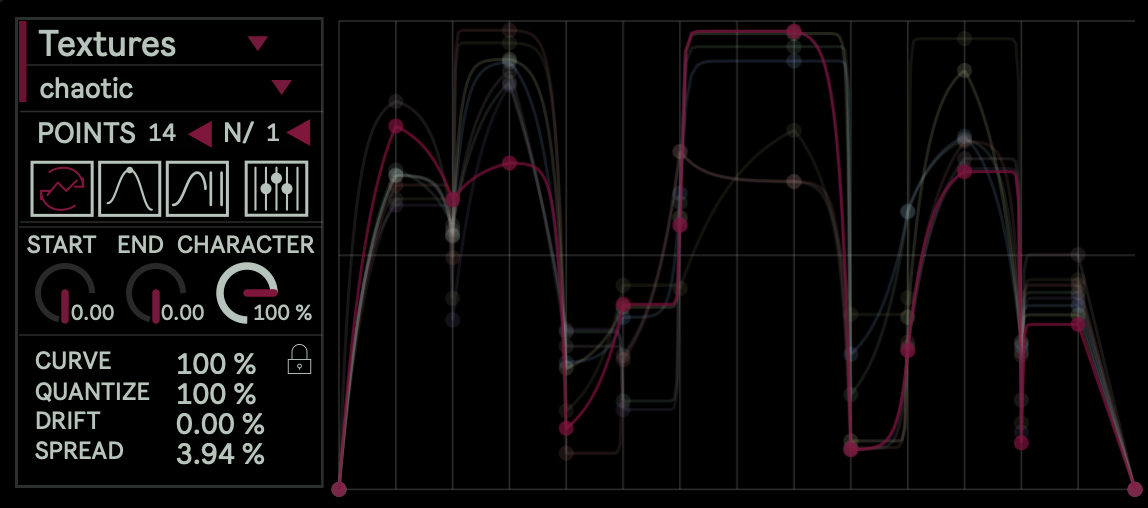
Concept: Tiny initial differences explode into radically different trajectories.
Character: low = edge-of-chaos, more structured variation; high = fully chaotic motion.
Drift: low = evenly spaced samples; high = growing temporal jitter along the envelope — later samples feel more displaced than early ones.
Spread: low = channels remain similar; high = tiny per-channel seed differences produce clearly different trajectories.
Try it for unstable, evolving movement that never loops the same way.
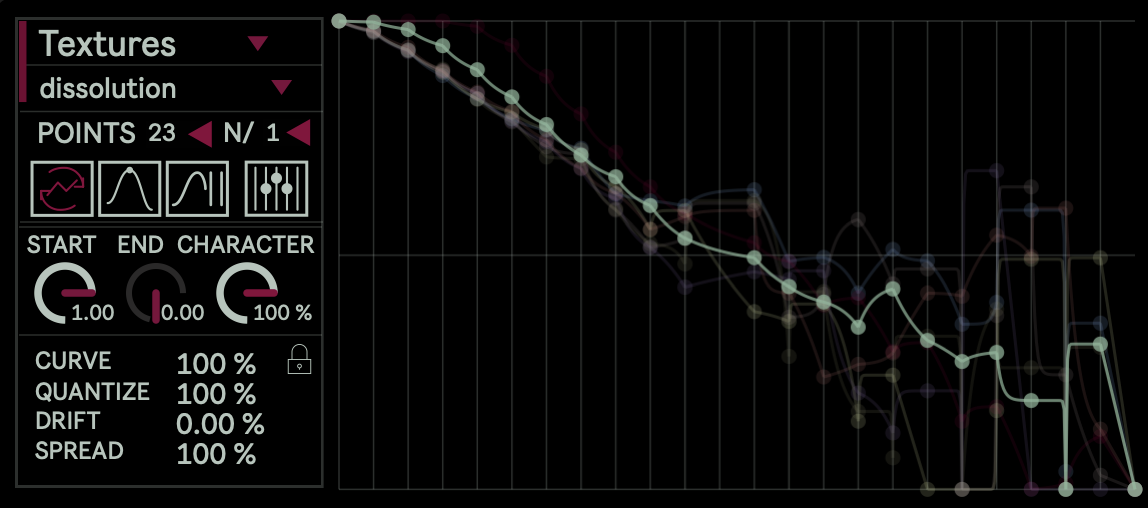
Concept: Order dissolves into debris over time.
Character: low = mostly intact trajectory; high = strong late-stage breakup and reduced smoothness.
Drift: low = dissolution stays in the late portion; high = dissolution starts earlier and feels rougher.
Spread: low = channels dissolve together; high = per-channel time offset — each channel breaks apart at a slightly different moment.
Try it for controlled decay from order to disorder.
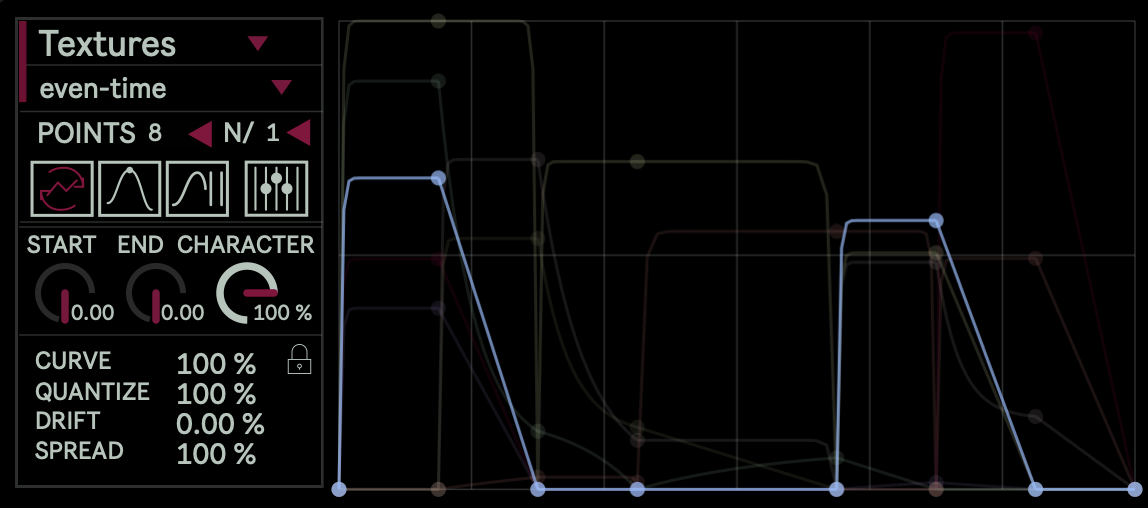
Concept: Stable clock, unstable amplitude.
Character: low = values stay near the straight path; high = values can deviate strongly.
Drift: low = adjacent values are independent; high = strong temporal correlation — values become smoothly linked instead of jumping.
Spread: low = channels share the same amplitude profile; high = per-channel windowed offset spreads the value paths apart in the middle.
Try it for reliable rhythm but unpredictable amplitude.
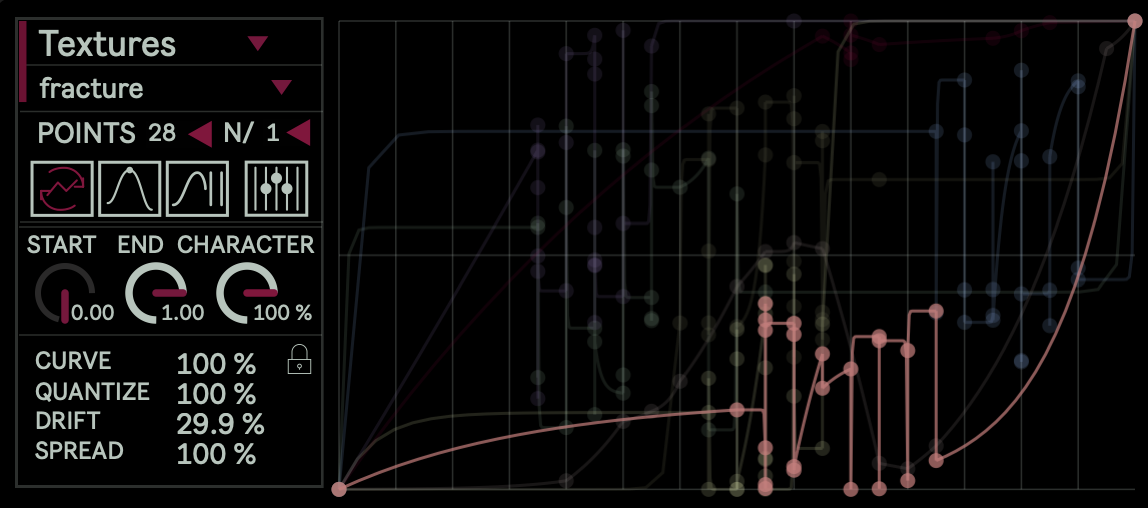
Concept: One gesture breaks apart into shards while still preserving an overall direction.
Character: low = mild internal breaks and short discontinuities; high = stronger fragmentation, harder jumps, and a more broken contour.
Drift: low = symmetric fracturing; high = amplified asymmetric erosion — one slope direction is smoothed while the other stays sharp, like wind-carved terrain.
Spread: low = channels share the same fractal roughness; high = per-channel roughness jitter — some channels carry smoother fractal landscapes, others more jagged ones.
Try it for damaged, interrupted motion that shatters a gesture into abrupt shards while still tracing an overall direction.
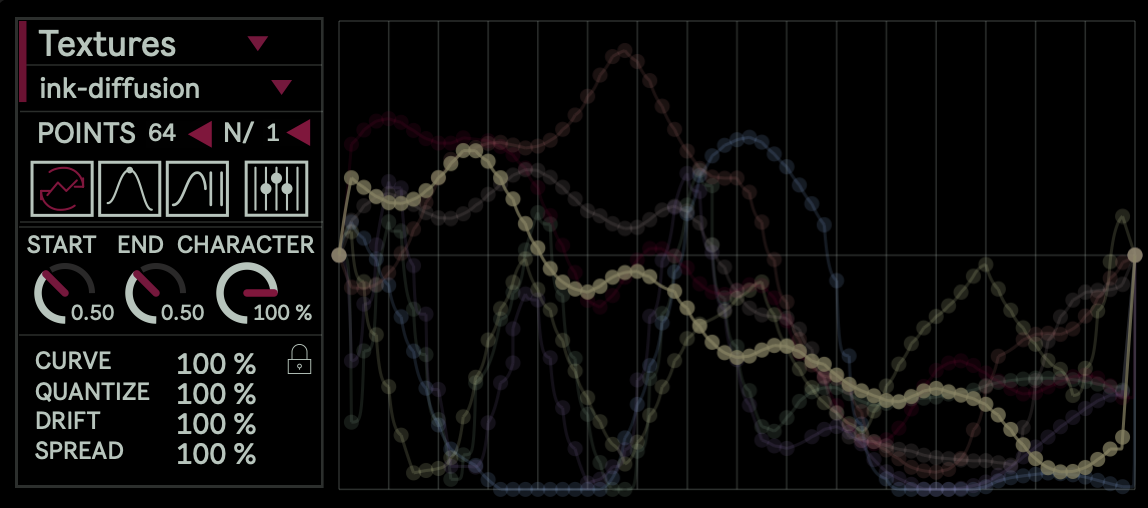
Concept: A stain that spreads and softens as it travels.
Character: low = thicker/viscous feel, slower spread; high = faster dilution and looser flow.
Drift: low = letterform and pressure held steady; high = slow value wandering and temporal displacement disturb the ink trace — the gesture feels less controlled.
Try it for smearing, bleed-like transitions, and soft organic drift.
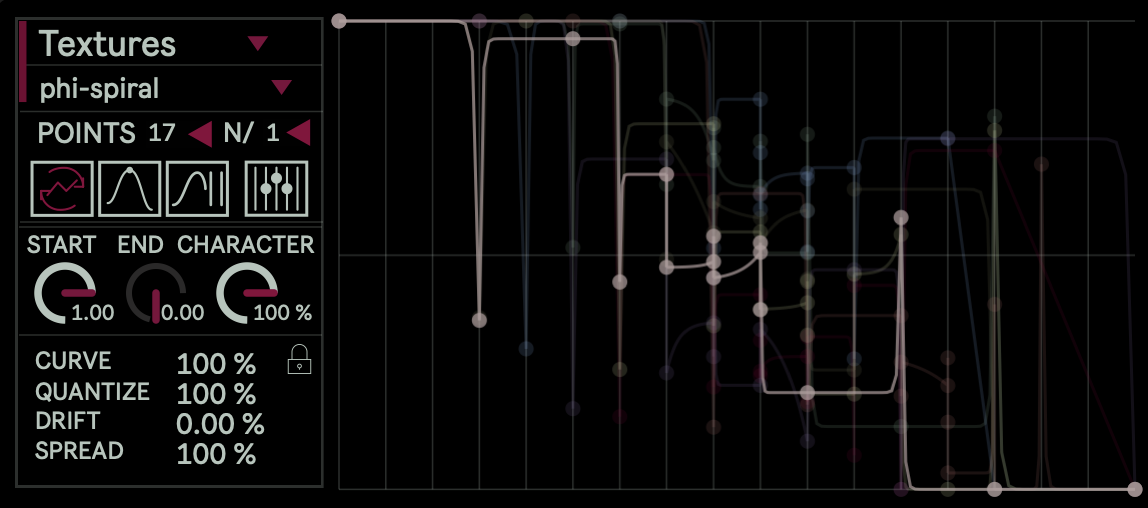
Concept: Organic asymmetry with hidden geometric order underneath.
Character: low = subtler position jitter and modulation; high = more jitter and stronger amplitude shaping.
Drift: low = tight φ geometry; high = peak positions disperse further from their geometric timing — the spiral feels more organic and less geometric.
Spread: low = channels share the same spiral; high = per-channel jitter of amplitude and pivot position — each channel traces its own spiral geometry.
Try it for natural asymmetry with an underlying sense of order.
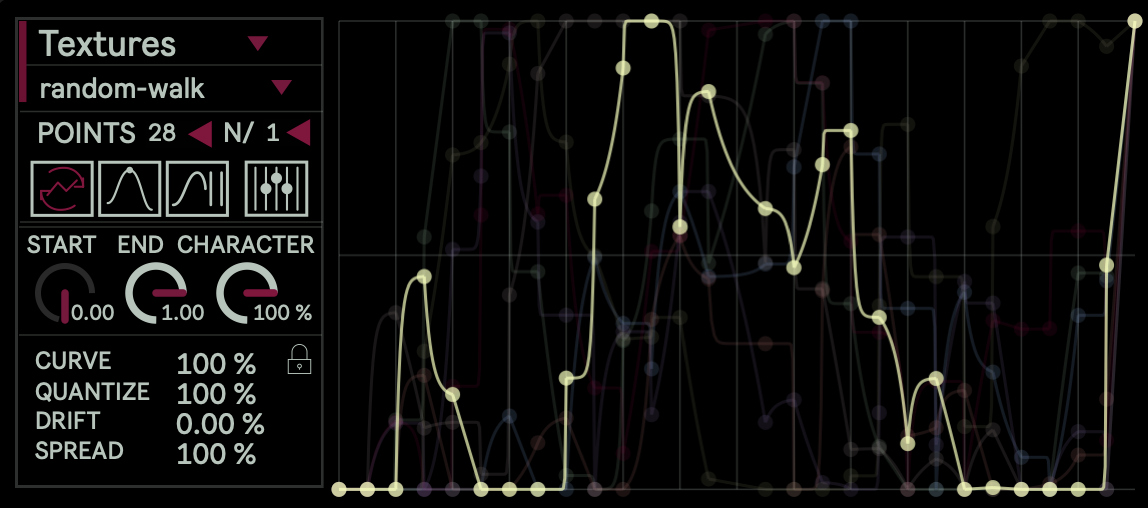
Concept: A path that meanders locally without a fixed long-term plan.
Character: low = small local moves, smoother path; high = larger steps, more erratic long-term direction.
Drift: low = each step is independent; high = step momentum (steps follow the previous direction) combined with a soft pull back toward the baseline.
Spread: low = channels share the same step size; high = per-channel step-amplitude jitter — some channels wander farther, others stay tight.
Try it for coherent local motion that remains globally unpredictable.
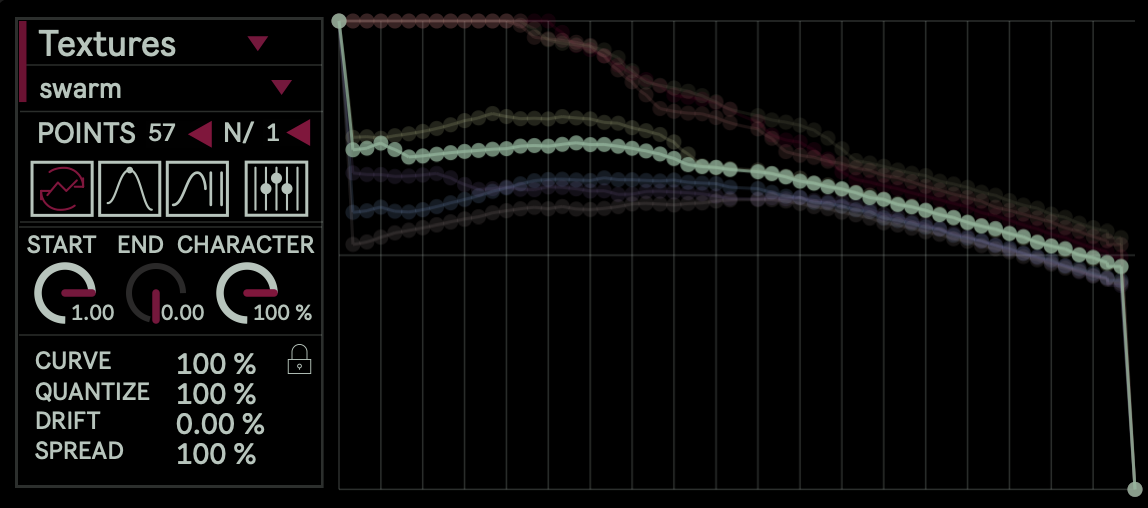
Concept: A crowd of small motions self-organizes into one shared destination.
Character: low = fewer agents and gentler variation; high = denser movement, wider channel differences, more complex texture.
Drift: low = smooth agent flight; high = in-flight velocity perturbations — the swarm feels restless and nervous.
Try it for modulation built from many small independent motions that scatter and then converge on a shared destination — a crowd finding its way to one point.
SEQUENCES
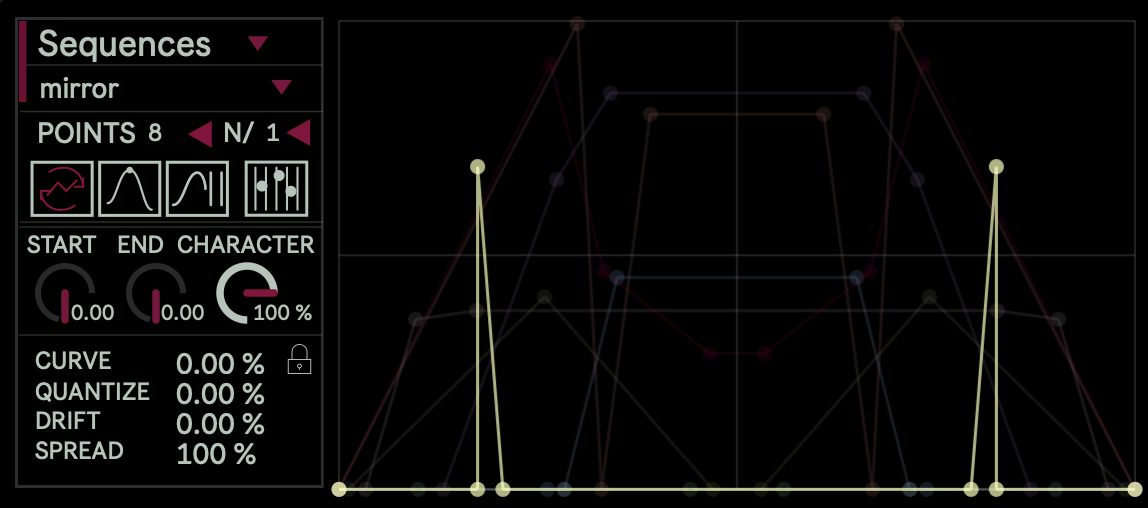
Concept: One half invents the motion, the other half answers it in symmetry.
Character: low = internal points stay close to the straight line; high = full amplitude range — the half-gesture swings widely.
Drift: low = symmetric shape held clean; high = slow value wandering and temporal displacement gradually alter the mirrored shape.
Setcurve: low = straighter segments; high = smoother and more rounded links.
Try it for balanced, symmetric motion that still feels alive.
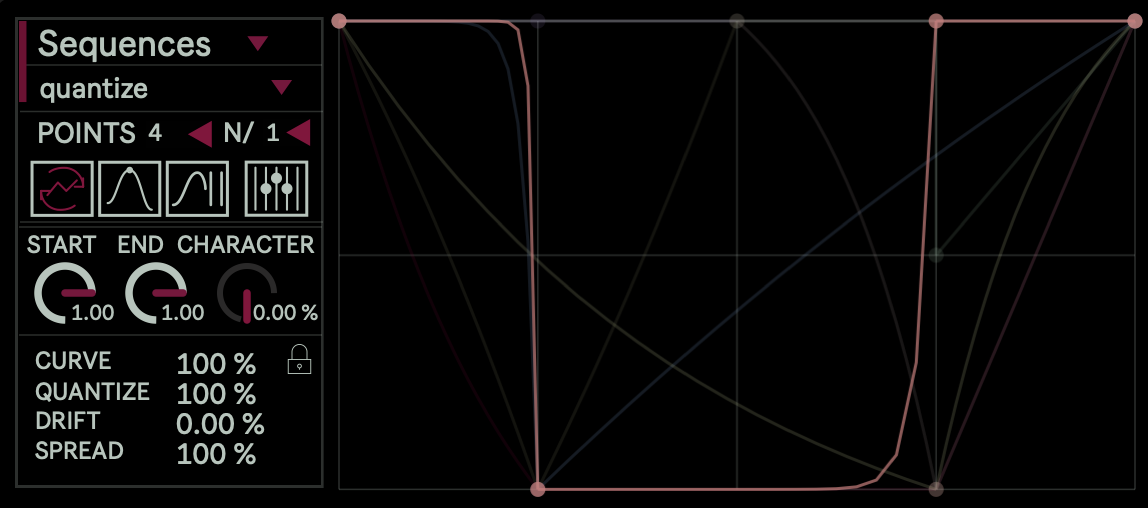
Concept: Free rhythm routed through a digital step grid.
Character: low = very coarse level set; high = many levels, close to continuous behavior.
Drift: low = every step picks a fresh level; high = higher probability of holding the previous level — long plateaus emerge.
Spread: low = all channels share the same grid resolution; high = per-channel level count — some channels snap coarser, others finer.
Try it for moving between hard digital stepping and near-analog smoothness.
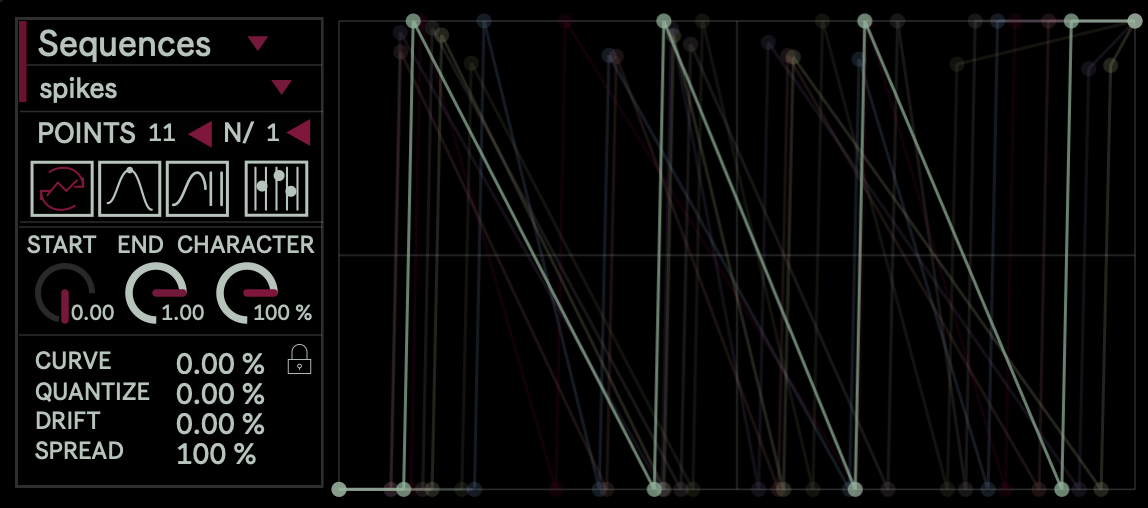
Concept: Quiet baseline punctuated by trigger-like hits.
Character: low = sparse spikes; high = dense spike activity.
Drift: low = spike timing and values stay as generated; high = slow value wandering and temporal displacement offset the baseline between spikes.
Spread: low = spikes land at regular intervals with the same apex; high = per-channel jitter of spike timing and apex value — channels trigger independently.
Try it for intermittent trigger-like activity inside a quiet envelope.
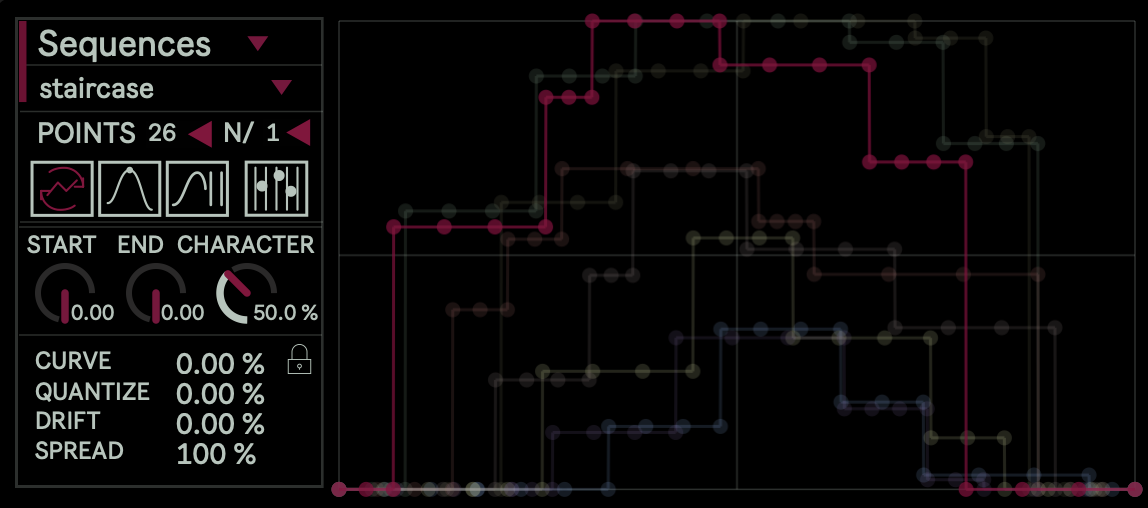
Concept: Structured step-by-step climb or descent with optional instability.
Character: low = fewer large steps; high = more, smaller steps.
Drift (in deterministic mode): low = stable step heights; high = noticeable height jitter.
Spread: low = channels stay aligned; high = per-channel height offset and step-duration variation increase.
Setcurve: low = flat plateaus; high = plateaus bend into alternating arcs.
Try it for sequencer-like climbs and descents whose plateaus can bend and whose step heights can waver, moving between rigid quantization and looser, breathing steps.
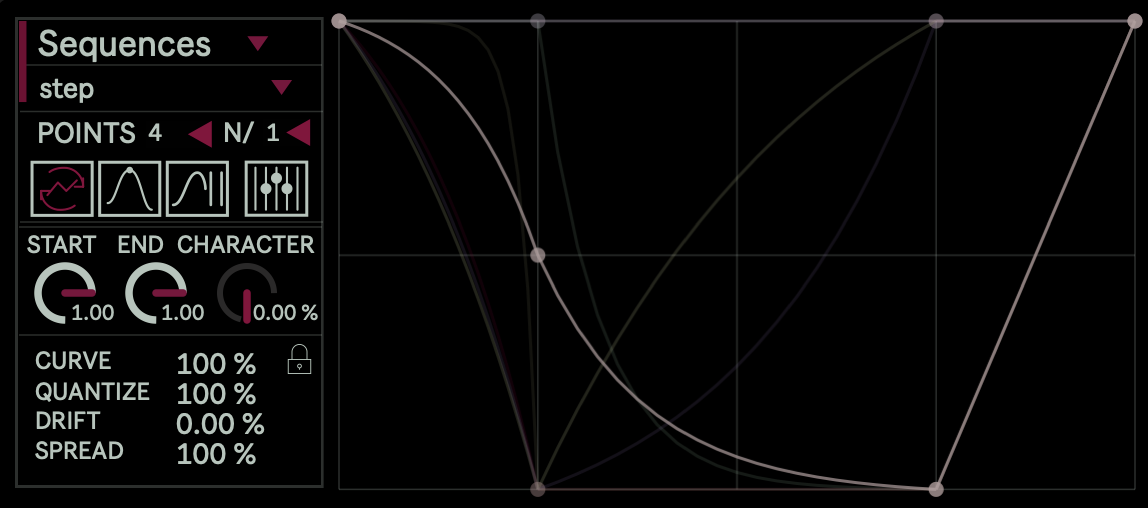
Concept: A minimal sequencer-style staircase.
Character: low = very few levels (binary feel); high = more levels and finer stepping.
Drift: low = every slot picks a fresh level; high = higher probability of holding the previous level — plateaus of varying length.
Spread: low = all channels share the same level count; high = per-channel grid resolution jitter.
Setcurve: low = hard edges; high = rounded transitions between steps.
Try it for sequencer-like modulation with clear plateaus.
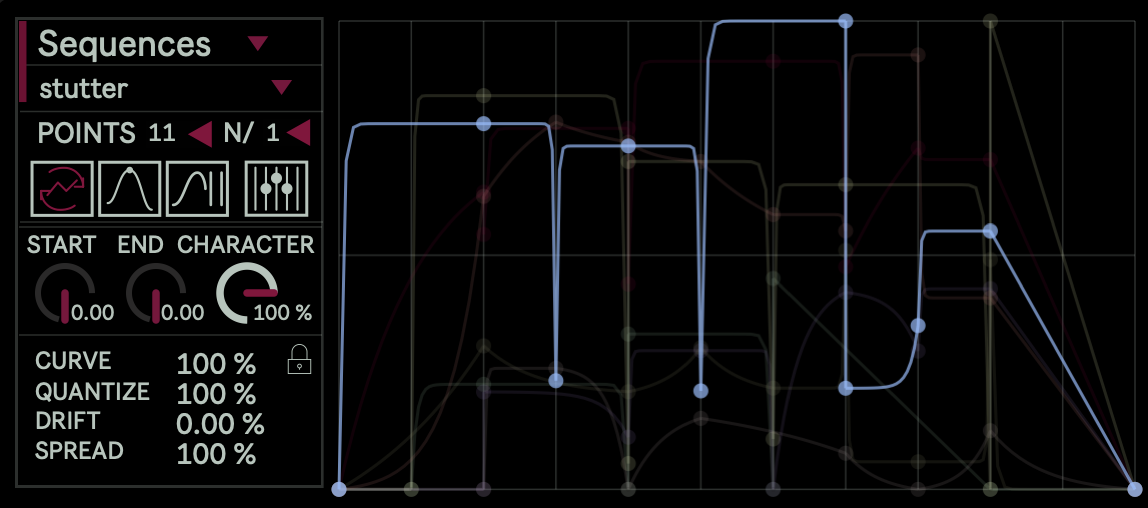
Concept: A looping memory that starts stable, then crumbles over time.
Character: low = almost exact repetition; high = heavy drift, erosion, and loss of motif identity.
Drift: low = degradation is additive noise — the motif breaks apart chaotically; high = erosion dominates — values converge toward a plateau and repetitions accelerate toward the end.
Spread: low = all channels stutter on the same motif; high = per-channel motif jitter and timing rubato — each channel loops a slightly different figure.
Try it for glitchy repetition that can move from tight loop to broken memory.
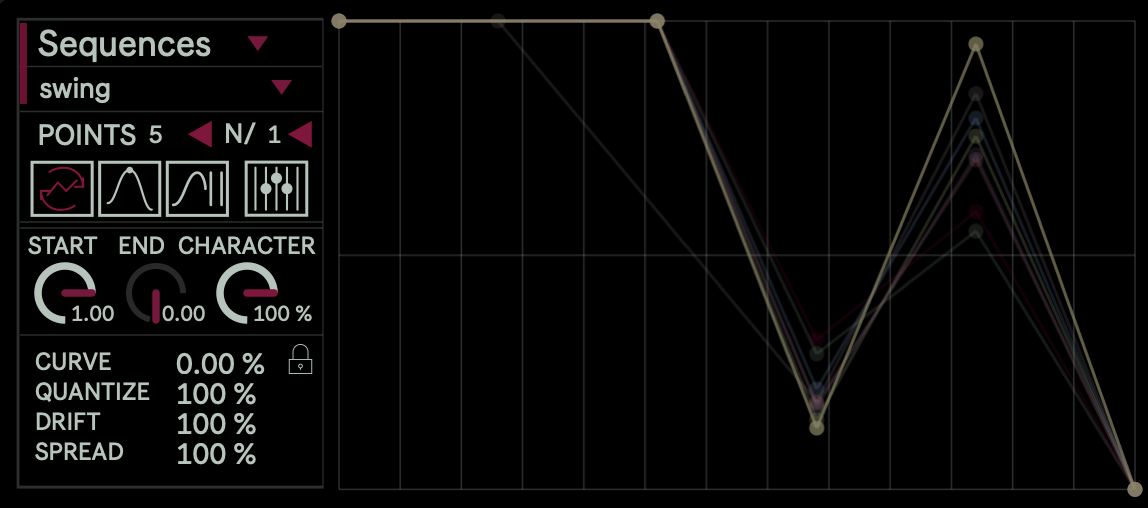
Concept: Straight timing is rephrased into a shuffle feel.
Character: low = near-straight timing with light jitter; high = strong long-short shuffle and larger value jitter.
Spread: low = channels groove similarly; high = channels diverge in swing texture.
Try it for injecting shuffle and groove — pushing pairs of events into a long-short feel so the envelope locks into a swung rhythmic pocket.